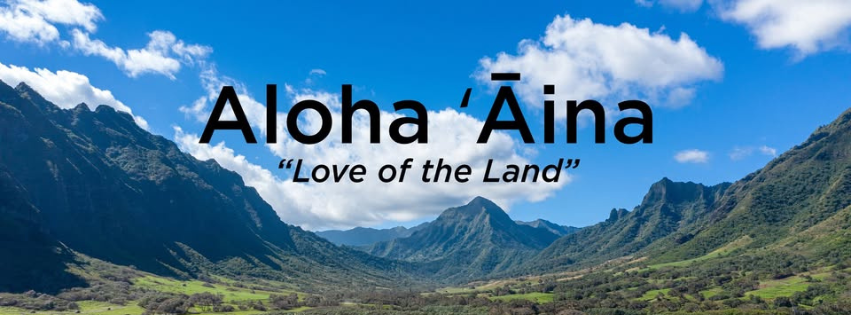
Aloha ʻĀina: Understanding the Love of the Land
There are certain cultural ideas that go beyond definition and become a way of seeing the world. Aloha ʻĀina is one of those ideas.
Often translated as “love of the land,” it carries a meaning that runs much deeper than simple appreciation for nature. It reflects a worldview rooted in connection—between people, the environment, and everything that sustains life.
In Native Hawaiian culture, Aloha ʻĀina is not just a phrase or philosophy. It is a lived experience, something that shapes daily life, values, and decisions.
It influences how people relate to the land, how they care for their communities, and how they understand their place in the world. It is both deeply personal and widely shared, grounding individuals in something larger than themselves.
A Relationship, Not Just a Concept
At its core, Aloha ʻĀina is about relationship. It’s not simply about loving the land in an abstract sense—it’s about recognizing that life is directly tied to it. The land feeds, supports, and sustains all living things. In return, people have a responsibility to care for it.
This relationship is built on mutuality. Humans depend on the land, but the land also depends on how it is treated.
That connection exists across multiple levels—spiritual, cultural, social, and even scientific. It reflects an understanding that everything is interconnected, and that no action exists in isolation.
The word ʻāina itself comes from the root “ʻai,” meaning “to eat” or “to nourish.” That meaning reinforces the idea that land is not just a place—it is a source of life. It feeds not only people, but entire ecosystems. When viewed through this lens, caring for the land becomes more than a responsibility—it becomes an act of respect and gratitude.
Aloha ʻĀina as Identity and Patriotism
Beyond its environmental meaning, Aloha ʻĀina also carries a sense of identity and belonging. It is often associated with Hawaiian patriotism, reflecting a deep love not only for the land itself but also for the people and culture connected to it.
This form of patriotism is different from what is often seen elsewhere. It’s not rooted in borders or political systems alone—it’s rooted in relationship. It’s about knowing a place, understanding its history, and feeling a sense of connection to the community that lives there.
Aloha ʻĀina encourages individuals to actively contribute to the well-being of Hawaiʻi. That might involve protecting natural resources, preserving cultural traditions, or supporting the local community. It’s not passive—it’s something that calls for action, driven by care and commitment.
Roots in Tradition and Story
The origins of Aloha ʻĀina trace back to ancient Hawaiian traditions and cosmology. It is reflected in creation chants like the Kumulipo, which describe the interconnected origins of all life. These stories emphasize that people and land are not separate—they come from the same source.
This connection is also expressed through cultural practices like hula, chant, and storytelling. These aren’t just forms of art—they are ways of preserving and expressing the relationship between people and the land. Even traditional practices like farming carry this meaning, often approached with a sense of reverence and celebration.
In everyday life, Aloha ʻĀina shows up in small but meaningful ways. It can be seen in how people care for their surroundings, how they share resources, and how they pass down knowledge through generations. It’s not something that exists only in theory—it’s something that is lived and experienced.
Aloha ʻĀina in History and Movement
While Aloha ʻĀina is deeply rooted in culture and spirituality, it has also played a role in Hawaiian history and political movements. In the late 19th century, the term became associated with efforts to protect Hawaiian sovereignty during a time of major change and upheaval.
Groups like the Aloha ʻĀina Party used the concept to express their commitment to the land and the people of Hawaiʻi. Over time, this connection between Aloha ʻĀina and political action grew, especially as issues of land use and cultural preservation became more prominent.
However, many practitioners emphasize that Aloha ʻĀina is not inherently political. Instead, it is a guiding principle—one that can lead to action in many forms. For some, that action may involve activism or advocacy. For others, it may be expressed through daily choices, cultural practices, or spiritual connection.
The Hawaiian Renaissance and Renewed Meaning
The concept of Aloha ʻĀina experienced a resurgence during the Hawaiian Renaissance of the 1970s. This period marked a renewed interest in Hawaiian language, culture, and identity. It was also a time of increased awareness around environmental and land-related issues.
Aloha ʻĀina became a unifying idea during this movement, bringing together people who were committed to protecting both the land and cultural heritage.
It connected environmental stewardship with cultural pride, creating a framework that felt both traditional and relevant to modern challenges.
This revival helped reintroduce Aloha ʻĀina to a new generation, reinforcing its importance as both a cultural value and a guiding philosophy.
Why Aloha ʻĀina Still Matters
Today, Aloha ʻĀina remains just as relevant as ever. In a world where environmental concerns and cultural preservation are increasingly important, its message feels both timely and timeless.
It offers a different way of thinking—one that prioritizes connection over separation, care over consumption, and responsibility over convenience. It encourages a deeper awareness of how actions impact the world, and a stronger commitment to protecting what sustains life.
Aloha ʻĀina isn’t just about loving the land. It’s about understanding that the land is part of life itself. And when that understanding is embraced, it changes not just how people live—but how they see the world around them.
Before we say "Aloha" ("goodbye"), we invite you to check out the Aloha Sun store to see what we have in stock.