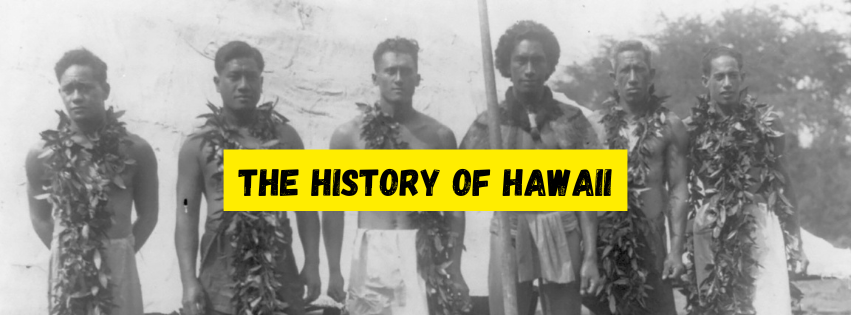
A Brief Look at the History of Hawaii
Hawaii’s history is layered, complex, and deeply rooted in culture, resilience, and transformation. Long before it became a global travel destination or the 50th U.S. state, these islands were home to a thriving, highly structured society built by skilled navigators who crossed vast stretches of ocean to get there.
Understanding how Hawaii evolved—from ancient Polynesian settlement to a unified kingdom, and eventually to statehood—adds a completely different level of appreciation to the islands today. Every beach, valley, and town carries pieces of that story.
What Is the History of Hawaii?

Early Polynesian Settlement
Hawaii’s story begins between 400 and 1200 AD, when Polynesian voyagers arrived by canoe from regions like the Marquesas and Tahiti. These weren’t случай explorers—they were expert navigators who used the stars, ocean currents, and wind patterns to travel thousands of miles across the Pacific.
Once settled, they developed a rich and organized society. At the center of this system was the kapu system, a strict set of laws and taboos that governed daily life, spirituality, and social structure. Chiefs, known as aliʻi, held authority, while kahuna (priests and specialists) guided religious and cultural practices.
Life was deeply connected to the land and ocean, with agriculture, fishing, and community cooperation forming the foundation of survival. Oral traditions, chants, and storytelling preserved history and knowledge across generations.

European Contact and Change
Everything began to shift in 1778, when James Cook became the first recorded European to arrive in Hawaii. He named the islands the “Sandwich Islands,” marking the beginning of sustained Western contact.
Cook returned the following year but was killed in 1779 at Kealakekua Bay after tensions escalated with Native Hawaiians. While his arrival opened the door to global awareness of Hawaii, it also introduced significant challenges.
Western contact brought trade, new technologies, and foreign influence—but it also introduced diseases that devastated the Native Hawaiian population. These changes set the stage for major political and cultural shifts in the years that followed.
The Rise of the Hawaiian Kingdom
In the late 18th century, a powerful leader emerged who would change Hawaii’s future forever. Kamehameha I used a combination of strategic alliances, warfare, and Western weapons to unify the Hawaiian Islands under one rule.
By 1810, he had successfully established the Kingdom of Hawaii, creating a centralized government for the first time in the islands’ history. This unification brought stability and laid the groundwork for Hawaii’s recognition as a sovereign nation.
One of his most notable contributions was the Law of the Splintered Paddle, a principle that protected civilians during times of war. It remains an enduring symbol of leadership and justice in Hawaiian culture.

Missionaries and Economic Transformation
The early 1800s brought even more change with the arrival of Christian missionaries in 1820. Their influence reshaped many aspects of Hawaiian life, including religion, education, and language.
By 1835, the first major sugar plantation was established, marking the beginning of a new economic era. Agriculture—particularly sugar and later pineapple—became the driving force behind Hawaii’s economy.
This shift also led to increased immigration, as workers from countries like Japan, China, and the Philippines came to Hawaii to work on plantations. Over time, this created the diverse cultural mix that Hawaii is known for today.
The Overthrow of the Monarchy
Despite being an independent kingdom, Hawaii faced growing pressure from foreign business interests, particularly American plantation owners.
In 1887, King Kalākaua was forced to sign what became known as the Bayonet Constitution, which significantly reduced the monarchy’s power and gave more control to foreign residents.
The situation escalated in 1893, when Queen Liliʻuokalani was overthrown by a group of American and European businessmen, supported by U.S. military forces. This marked the end of the Hawaiian monarchy.
The overthrow remains one of the most controversial and deeply impactful events in Hawaii’s history, with lasting cultural and political implications that are still discussed today.
Annexation and Statehood
Following the overthrow, Hawaii was annexed by the United States in 1898 and became a U.S. territory in 1900. Over the next several decades, its strategic location in the Pacific made it increasingly important, especially during World War II.
The attack on Pearl Harbor in 1941 brought global attention to Hawaii and played a major role in shaping its path forward.
Finally, on August 21, 1959, Hawaii officially became the 50th U.S. state, marking a new chapter in its history.

Cultural Resilience and Modern Hawaii
Despite the many changes and challenges, Native Hawaiian culture has remained strong. Efforts to preserve language, traditions, and land rights have continued for generations.
In 1993, the United States formally apologized for its role in the overthrow of the Hawaiian Kingdom, acknowledging the historical injustices faced by Native Hawaiians.
Today, Hawaii stands as a place where ancient traditions and modern life exist side by side. Its history is not just something to learn—it’s something that continues to shape the identity of the islands and the people who call them home.
Understanding that history adds depth to every visit, turning Hawaii from a destination into a story that’s still being written.