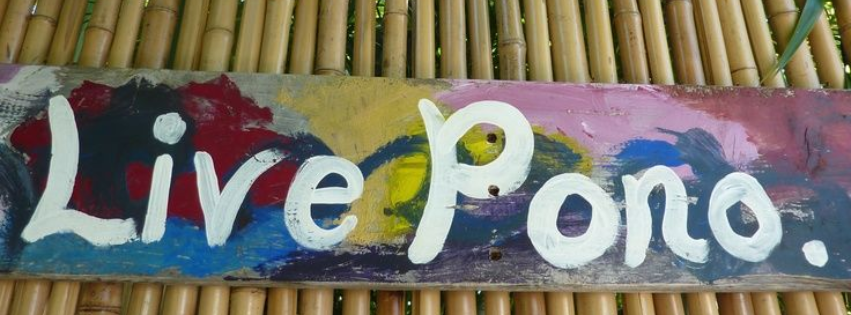
What Does Pono Mean in Hawaiian?
The Hawaiian word pono carries a meaning that goes far beyond a simple English translation. It is commonly associated with righteousness, balance, integrity, and doing what is right. In Hawaiian culture, being pono can describe the way a person treats themselves, other people, their community, and the land around them.
That makes pono less like a single rule and more like a guiding principle. It is about finding the right relationship between actions, intentions, people, and the world.
Depending on the context, pono can also describe something that is proper, fair, beneficial, or done correctly. Its flexibility is part of what makes the word so meaningful.
Pono Is About Balance and Harmony
One important idea connected to pono is balance. To live pono means to seek harmony rather than creating unnecessary conflict or imbalance.
That harmony can exist on several levels. A person can strive to be in balance with their own values while also maintaining respectful relationships with family, friends, neighbors, and the wider community. There is also an important connection to the natural environment and the land.
This broader understanding makes pono a principle that reaches beyond individual behavior. A decision may benefit one person, but if it harms others or damages the environment, it may not represent the larger idea of living pono.
In that sense, balance involves considering the consequences of choices and recognizing that personal well-being is connected to the well-being of others.

Doing What Is Right
Pono is also closely associated with righteousness and moral action. To be pono means to make choices that are fair, honest, respectful, and guided by good intentions.
That doesn't necessarily mean there is always one simple answer to every situation. Instead, the concept encourages people to think carefully about whether their actions are appropriate and whether they contribute positively to the people and world around them.
Kindness and integrity are therefore important parts of the idea. Being pono can mean treating someone with respect, acting honestly, keeping a commitment, or making a decision based on what is right rather than what is easiest.
Pono Can Mean Doing Something Properly
Another dimension of pono involves doing things the right way.
In this context, the word can describe proper procedure, appropriate behavior, or an action carried out correctly and with care. Intent matters, but so does the way something is actually done.
That gives pono a practical quality. It isn't only about having good thoughts or intentions. It can also involve taking the time to handle responsibilities properly and respectfully.
This meaning can apply to everyday situations, relationships, responsibilities, and interactions with the surrounding environment.
Pono and Hawaii’s State Motto
Perhaps the most familiar appearance of pono outside everyday Hawaiian usage is in Hawaii's state motto:
Ua Mau ke Ea o ka ʻĀina i ka Pono.
The motto is commonly translated as “The life of the land is perpetuated in righteousness.”
The phrase connects the idea of pono directly with the land. It reflects the importance of righteousness and the relationship between the well-being of the people and the land itself.
Because pono appears in the state motto, the word has become recognizable well beyond Hawaii. But its significance extends much further than its appearance in a familiar phrase.
What Does It Mean to “Be Pono”?
The expression “be pono” can be used as a reminder to act with kindness, respect, honesty, and integrity.
For children growing up in Hawaii, the concept can be introduced as part of learning how to interact appropriately with other people and the world around them. It provides a simple way of expressing the importance of making good choices and treating others properly.
The idea can apply to both major decisions and ordinary moments. Helping someone, respecting the land, keeping your word, or considering how an action affects another person can all fit within the broader idea of living pono.
Pono Has More Than One Meaning
One reason pono can be difficult to translate into a single English word is its versatility. While righteousness and balance are among its best-known meanings, the word can also relate to ideas such as well-being, prosperity, duty, correctness, and what is necessary or appropriate in a particular situation.
Its meaning can therefore shift depending on how it is being used.
Rather than thinking of pono as having one exact definition, it can be more useful to understand it as a concept centered on what is right, proper, balanced, and beneficial.
Why Pono Still Matters
Pono remains a powerful Hawaiian concept because it connects personal behavior with something larger. It encourages people to consider how their choices affect themselves, other people, their communities, and the land.
At its heart, the idea is about living with integrity and respect while seeking balance.
That makes pono much more than a word used to describe something “right.” It represents a way of thinking about responsibility, relationships, and harmony—and helps explain why such a short Hawaiian word can carry such a broad and lasting meaning.