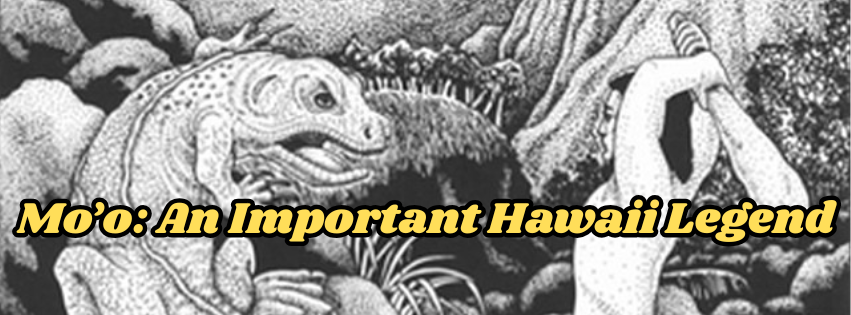
Moʻo: The Shape-Shifting Guardians of Hawaiian Legend
If someone hears the word moʻo while visiting Hawaii, they might assume people are talking about the tiny geckos darting across walls after sunset.
Sometimes they are. But in Hawaiian culture, the word carries a much deeper meaning.
Depending on the context, a moʻo can be a legendary water guardian, an ancestral protector, an everyday house gecko, or even a symbol connected to genealogy and storytelling. It's one of those Hawaiian words that reveals how closely nature, history, and spirituality are woven together.
The more you learn about moʻo, the more you realize they're far more than simple lizards.

Moʻo: Guardians of Hawaii's Fresh Water
Long before modern maps and water systems existed, freshwater sources were among Hawaii's most valuable natural resources.
Streams, ponds, springs, and waterfalls made life possible, so it's no surprise that many legends describe powerful beings watching over these places. Those beings were often moʻo.
Traditional Hawaiian stories portray them as enormous reptilian creatures resembling giant lizards or dragons. They lived near freshwater pools and hidden caves, protecting the places that sustained both people and wildlife.
Some legends describe them as helpful guardians that rewarded those who respected the land.
Others portray them as dangerous protectors willing to defend their territory from anyone who acted carelessly or dishonorably.
In either case, they served as powerful reminders that nature deserved respect.
Masters of Transformation
One of the most fascinating qualities of the moʻo is the ability to change form. Unlike many mythical creatures that remain fixed in one appearance, moʻo are famous for their shape-shifting abilities.
They could appear as enormous reptilian guardians one moment and transform into ordinary humans the next.
Many stories describe them taking the form of beautiful women who interacted with travelers without revealing their true identities. In other tales, they became tiny geckos that could quietly observe people without attracting attention.
These transformations allowed the moʻo to move freely between the spiritual and human worlds, making them mysterious figures whose true nature was often hidden beneath an ordinary appearance.
Protectors of Families
Not every encounter with a moʻo was something to fear. For many Native Hawaiian families, certain moʻo were considered ʻaumakua, or ancestral guardian spirits.
An ʻaumakua serves as a protector that watches over descendants, offering guidance, warnings, or protection during difficult times. These family guardians could appear in many forms, and for some families, the moʻo held that sacred role.
Rather than representing monsters, these spirits symbolized an ongoing connection between generations, reminding descendants that they remained linked to those who came before them.
Respecting the land often meant respecting the guardian spirits believed to care for it.
The Little Geckos Everyone Knows
Today, most people in Hawaii encounter moʻo in a much smaller form. The tiny geckos that climb walls, hide near porch lights, and quietly hunt insects after dark are commonly called moʻo in everyday conversation.
Unlike their legendary counterparts, these small reptiles are harmless and welcome guests in many homes.
They spend their evenings catching mosquitoes, moths, flies, and other insects, making them natural pest control.
Many residents hardly think twice when they spot one resting on a ceiling or window. Although they're ordinary animals, sharing the same name as Hawaii's legendary guardians reflects the lasting influence of traditional stories on everyday language.

More Than Just a Lizard
The word moʻo carries another layer of meaning that surprises many people.
According to respected Hawaiian language scholar Mary Kawena Pukui, moʻo can also describe a succession, sequence, or connected line.
That idea appears most clearly in the word moʻokūʻauhau, which refers to genealogy or family lineage.
The connection comes from the spine of a lizard. Each vertebra links to the next, forming one continuous chain. In the same way, generations connect to create an unbroken family history stretching across time.
This beautiful comparison reflects a larger Hawaiian worldview, where the natural world often provides language for understanding human relationships.
Stories That Connect Generations
Genealogy isn't the only tradition connected to the word moʻo. It also relates closely to moʻolelo, the Hawaiian word for stories, history, and oral tradition.
For centuries, Hawaiian knowledge was passed from one generation to another through spoken storytelling rather than written records.
These stories preserved family history, cultural values, important events, and lessons about living in harmony with nature. Just as each vertebra forms part of a spine, each story becomes another link connecting past and present.
The language itself reflects that relationship, showing how deeply storytelling is woven into Hawaiian culture.
A Living Part of Hawaiian Tradition
Today, the moʻo continues to appear throughout Hawaiian art, literature, education, and cultural discussions.
Visitors exploring waterfalls or freshwater pools may hear local legends describing ancient guardian spirits associated with those places.
Children still learn stories about shape-shifting moʻo alongside other important figures in Hawaiian mythology.
Meanwhile, the little geckos running across lanais each evening quietly remind people of the same word's everyday meaning.
It's rare for a single term to carry so many different layers of significance, but that's exactly what makes the moʻo so fascinating.
Whether viewed as a legendary protector of freshwater, an ancestral guardian spirit, a harmless neighborhood gecko, or a symbol of genealogy and storytelling, the moʻo represents connection. It connects people to nature, families to their ancestors, and modern Hawaii to traditions that have endured for generations.
That's why the moʻo remains one of the most meaningful and enduring figures in Hawaiian culture—its story continues to evolve while never losing sight of where it began.