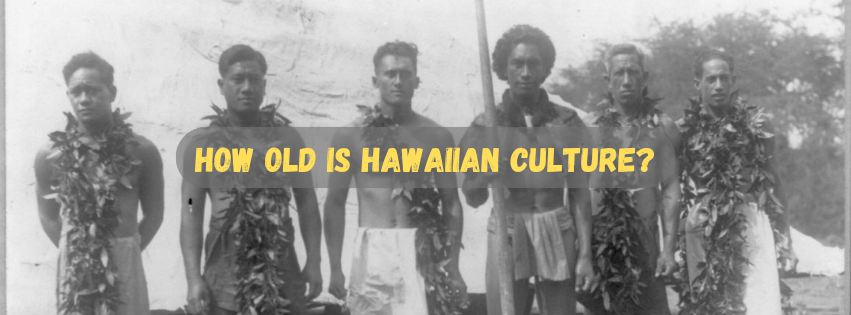
How Long Has Hawaiian Culture As We Know It Been Around?
When people think about Hawaiian culture, they often picture hula, surfing, traditional music, or the spirit of aloha. What many don't realize is that Hawaiian culture stretches back more than a thousand years—and its roots go back even further than the Hawaiian Islands themselves.
So, how old is Hawaiian culture?
The short answer is that Hawaiian culture has existed for at least 800 to 1,500 years in the islands. The longer answer is much more fascinating because Hawaiian culture didn't suddenly appear after people arrived in Hawaii. It evolved from a much older Polynesian heritage that had already flourished across the Pacific for centuries.
Let's take a closer look at where Hawaiian culture came from and how it developed into the unique traditions that continue to thrive today.
A Culture That Crossed an Ocean
The story of Hawaiian culture begins thousands of miles away from Hawaii.
The first settlers were Polynesian navigators who accomplished one of history's greatest feats of exploration. Without modern maps, compasses, or GPS, they crossed vast stretches of the Pacific Ocean using only the stars, ocean currents, wind patterns, cloud formations, and their remarkable knowledge of nature.
These master navigators traveled in large double-hulled canoes, carrying everything they needed to build new communities.
They brought essential "canoe crops" like taro, breadfruit, bananas, coconuts, and sweet potatoes, along with animals such as pigs, chickens, and dogs.
Those voyages laid the foundation for what would eventually become Hawaiian civilization.
When Did People First Arrive in Hawaii?
For many years, historians believed the first Polynesians reached Hawaii sometime between 400 and 800 CE.
Modern archaeological research, however, suggests that permanent settlement likely became established later, with the largest waves of migration occurring between approximately 1000 and 1200 CE.
Most researchers believe there were two major migration periods.
The earliest voyagers likely arrived from the Marquesas Islands, while later migrations came from Tahiti and the Society Islands. These later settlers brought additional cultural traditions, religious practices, political structures, and advanced agricultural knowledge that helped shape Hawaiian society.
Although scholars continue to refine the timeline, there is broad agreement that Hawaiian culture has been developing on the islands for well over a thousand years.

Isolation Created Something Unique
After the first settlers arrived, Hawaii became one of the most isolated inhabited places on Earth.
For centuries, there was little or no contact with the outside world. That isolation allowed Hawaiian culture to evolve in its own direction.
Communities developed sophisticated farming systems, fishponds, irrigation networks, navigation knowledge, religious traditions, and systems of government that were uniquely adapted to the islands.
Over generations, the Hawaiian language also developed into its own distinct form while maintaining its Polynesian roots.
A Deep Connection to Nature
One of the defining characteristics of Hawaiian culture is its relationship with the natural world.
Traditional Hawaiian chants describe the islands, the ocean, plants, animals, winds, volcanoes, and people as interconnected parts of a single living system.
Rather than viewing humans as separate from nature, Hawaiian tradition teaches that everyone has a responsibility to care for the land and each other.
This principle is known as mālama, which means to care for, protect, and nurture. That philosophy continues to influence modern Hawaiian life, conservation efforts, and cultural practices throughout the islands.
The Meaning of Aloha
Perhaps no Hawaiian word is more recognized around the world than aloha.
While many visitors understand it simply as a greeting, aloha carries a much deeper meaning. It reflects kindness, compassion, respect, generosity, and recognizing the shared humanity between people.
The spirit of aloha encourages individuals to treat others with dignity while also respecting future generations and the environment.
These values continue to shape Hawaiian culture today through music, storytelling, hula, community gatherings, and everyday interactions.

Hawaiian Culture Continues Today
Although Hawaii has changed dramatically over the centuries, traditional culture remains very much alive.
Hula continues to preserve history through dance. Chanting passes down ancient stories. Traditional navigation has experienced a remarkable revival, with modern voyaging canoes once again crossing the Pacific using ancestral techniques.
The Hawaiian language, which nearly disappeared during the twentieth century, has also experienced an extraordinary resurgence through immersion schools and cultural preservation efforts.
Far from being a relic of the past, Hawaiian culture continues to evolve while honoring its ancient foundations.
Native Hawaiians Today
Today, approximately 680,000 people in the United States identify as Native Hawaiian, either alone or in combination with other ancestries.
Because of centuries of intermarriage following Western contact, most Native Hawaiians today have mixed ancestry.
People of entirely Native Hawaiian ancestry still exist, but they represent a very small portion of the overall Native Hawaiian population.
One place often associated with preserving traditional Hawaiian language and customs is Niʻihau, sometimes called the "Forbidden Island."
Because the island is privately owned and access is highly restricted, many residents continue to speak Hawaiian as their primary language and maintain many traditional cultural practices.
Meanwhile, due largely to Hawaii's high cost of living, more Native Hawaiians now live on the U.S. mainland than in Hawaii itself, with particularly large communities in states such as California and Washington.
A Legacy That Continues to Inspire
Hawaiian culture has survived centuries of change, outside influence, political upheaval, and modernization while continuing to preserve its identity.
Its teachings about caring for the land, respecting ancestors, living in harmony with nature, and treating others with aloha remain just as meaningful today as they were generations ago.
Many people believe these values offer important lessons for a modern world facing environmental challenges and increasing social division.

More Than a Thousand Years of History
So how long has Hawaiian culture been around?
On the Hawaiian Islands themselves, its history stretches back well over a thousand years. But its true origins reach even deeper into the ancient Polynesian world, where generations of master navigators, explorers, and settlers developed traditions that eventually crossed thousands of miles of open ocean.
Those voyagers didn't simply discover new islands—they carried with them a rich cultural foundation that would grow into one of the world's most unique civilizations.
Today, Hawaiian culture remains a living tradition that continues to honor its remarkable past while inspiring future generations through its enduring values of aloha, mālama, resilience, and respect for the natural world.