Hawaiian Mythology: 14 Gods, Goddesses, and Legendary Figures
In the heart of the Pacific lie the Hawaiian Islands, a place where every mountain, every river, and every rock has a story to tell. These lands have been home to a people whose roots mingle with those of the gods and spirits of nature.
At a time when the world was young, the first Polynesians set sail into the unknown, shaping a unique civilization on these volcanic islands. Over the centuries, these stories have echoed in dances, songs, and traditions that have survived to this day.
In the year 1778, British explorer James Cook set foot on these lands, ushering in a new era of change and conquest. But even through the trials of time, the Hawaiian spirit has persevered and preserved its rich mythological heritage.
Today, explore the mythological heart of Hawaii through the stories that have shaped its people and its land.
The Most Powerful and Important Hawaiian Gods
1. Pele
Pele is without a doubt one of the most iconic and revered deities in Hawaiian mythology. Known as the goddess of fire, she is credited with creating the Hawaiian Islands through volcanic eruptions and is often said to reside in Kilauea volcano, one of the most active volcanoes in the world.
Pele is known for her passionate and sometimes volatile nature. Stories describe her as having a strong temper that can easily become inflamed, but also a great capacity for love and compassion.
According to legend, the Hawaiian Islands were created by Pele's eruptions. She traveled from Tahiti, fleeing from her sister, the sea goddess Namakaokahai, and found refuge in Hawaii, forming the islands in the process.
Pele is said to have moved from island to island, creating and destroying land with her volcanic power before finally settling in the crater of Kilauea volcano on Hawaii's Big Island.

2. Hiiaka
Hiiaka is a significant figure in Hawaiian mythology, particularly in stories related to the volcano goddess Pele.
One of her most famous stories centers on her journey to bring Lohiau, Pele's lover, from the island of Kauai to Pele's abode. During this journey, she faces numerous challenges, battles monsters, and encounters supernatural beings in the form of lizards, demonstrating her power and skill.
Although she eventually succeeds in her mission, her return is complicated by the fact that Pele, impatient and jealous, destroys the forest and Hiiaka's beloved human in response.
Hiiaka defies her sister by dancing a powerful and provocative hula and kissing Lohiau in front of Pele. This leads to conflict between the two sisters, although they eventually reconcile.
Hiiaka is revered as the goddess of hula dancing and singing. Her story has been told and performed through hula for generations. She is also known for her healing abilities and is invoked in rituals and prayers related to health and wellness.

3. Namaka
Namaka, also called Namakaokahai, is one of the oldest Hawaiian deities, belonging to a family of gods and goddesses who rule the natural forces of the Hawaiian archipelago.
She is the daughter of Haumea, an important figure in Hawaiian mythology associated with fertility and birth.
Although depictions of Namaka can vary, she is often visualized as a powerful and majestic woman representing the vastness and power of the ocean. Her imagery is closely associated with water, waves, and the sea.
As the goddess of the sea, Namaka is intrinsically related to the oceans surrounding the Hawaiian Islands. She has the power to control tides and sea storms and is the protector of ocean creatures.
She is a powerful and sometimes fearsome force.
Namaka is probably best known for her relationship with her sister Pele, the goddess of fire and volcanoes. According to legend, the two sisters had a violent conflict that led to the creation of the Hawaiian Islands through volcanic eruptions and interactions with the sea.
The conflict between the two represents the eternal struggle between fire and water and provides a mythical explanation for the volcanic activity of the islands.

4. Ku
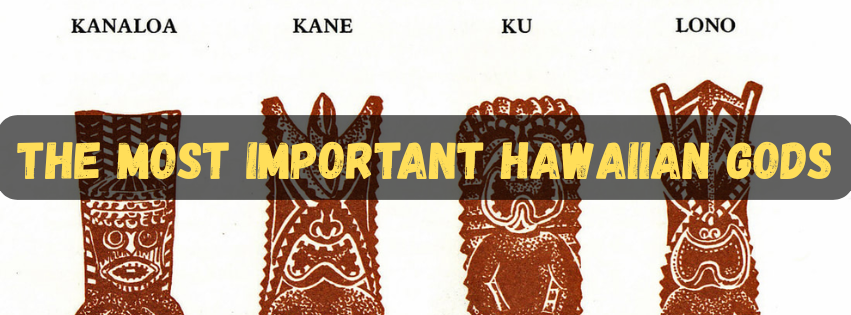
In Hawaiian mythology, Ku is one of the four main deities, along with Kanaloa, Lono, and Kane.
He is known primarily as the god of war but also represents fishing, agriculture, canoeing, and rain.
As the god of war, Ku is invoked to ensure victory in battle. During times of war, temples, or heiau, were built in his honor to ask for his protection and guidance.
Ku is known to have various manifestations or forms. One of his most revered manifestations is Kukailimoku, meaning "land plucker" or "land conqueror," which symbolizes the expansion and growth of the kingdom.
During certain rituals or before wars, human sacrifices were performed at Ku's temples to gain his favor. These sacrifices were a significant and powerful part of the ancient Hawaiian religion and demonstrated devotion and respect for Ku.

5. Lono
Lono is one of the four main gods of Hawaiian mythology. He is revered as the god of peace, fertility, agriculture, and rainfall.
He is responsible for providing Hawaii with abundant rainfall and ensuring a fruitful harvest. As such, he was a crucial deity in a culture that relied heavily on agriculture.
Lono is central to the Makahiki festival, which celebrates the rainy season and the harvest.
The festival lasted several months, beginning in approximately November and ending in February. During this time, wars were suspended and the focus shifted toward games, sports, dances, and offerings to Lono.
Symbols traditionally associated with Lono include sacred staffs, fishing nets, and rain sticks, reflecting his dominion over agriculture and water.
With his gentle nature and important role in agriculture and rainfall, Lono represents sustainable living and harmony with the land.

6. Kane
Kane is revered as the god of sunlight and life. He is also considered the creator of man and the father of all living things in Hawaii.
He is credited with creating the heavens and the Earth. In some myths, he is described as the creator of the first human beings, forming them from red clay.
Representing light, Kane is a symbol of life and growth. As the sun god, his presence is essential to the existence and survival of all forms of life on the islands.
He is also associated with fresh water. The springs and streams in Hawaii are considered physical manifestations of Kane.

7. Kanaloa
Kanaloa is widely recognized as the presiding deity over the oceans and deep waters.
He is often invoked by fishermen and sailors to ensure safe voyages and an abundant catch.
Kanaloa is often associated with Kane, the god of the sun and life. Together, they represent complementary forces in nature.
In some stories, Kanaloa is described as the ruler of the realm of the dead or the underworld, connecting him to concepts of death and regeneration.
The octopus is a symbol associated with Kanaloa, representing the vast and mysterious depths of the ocean.
In one story, Kanaloa and Kane travel the world together. Kane creates freshwater springs by striking the Earth with a magical staff, while Kanaloa, attempting to imitate Kane, creates salty springs, reinforcing his connection to the sea.
In another story, Kanaloa is portrayed as defiant of the gods and eventually banished to the underworld for his actions.

8. Hina
Hina is widely recognized as the deity representing the moon in Hawaii.
In some traditions, she is described as the mother who gives birth each night to the moon and places it in the sky.
She is considered the patron of workers, especially those who work with tree bark and make kapa, a traditional material made from bark.
In some versions of Hawaiian mythology, Hina is the mother of Maui, the Polynesian demigod famous for his heroic deeds.
In one particular story, Hina is chased by a monstrous being, and Maui kills it, transforming its body into the first coconut tree.
Other tales tell how Hina, tired of her earthly troubles, decided to visit the underworld. Her journey is filled with challenges and adventures that lead her to interact with other gods and mystical creatures.

9. Poliʻahu
Poliʻahu is the main Hawaiian goddess associated with snow, ice, and cold.
Her home is said to be Mauna Kea, the highest peak in the Hawaiian Islands, which is often covered with snow during winter.
She is described as a goddess of breathtaking beauty with cold, pale skin that reflects her wintry nature.
The most famous story involving Poliʻahu relates to her feud with Pele, the goddess of fire and volcanoes.
The two divinities competed in a game of hula. When Pele realized she was losing, she unleashed her volcanic fury.
However, Poliʻahu proved to be just as powerful, covering Pele's fire with snow and ice.
Despite her cold nature, Poliʻahu has numerous romantic stories and legends associated with her. One of the most popular tales tells of a mortal who falls in love with her without realizing her divine identity.

10. Kamapuaʻa
Kamapuaʻa has the power of transformation, although he is most famous for his pig-man form.
He can also assume the shape of a fish, a fern, or even rain.
It is said that he was born as a mortal and suffered the ostracization of his family because of his pig-like appearance. However, despite this difficult beginning, he rose to become a powerful warrior and demigod.
Kamapuaʻa and Pele have a complicated relationship filled with passion and conflict.
In one of the best-known stories, after a fierce battle with Pele, Kamapuaʻa manages to appease her fury, and the two become lovers.
However, their relationship is short-lived and fraught with conflict.
Despite the hardships he faced in his youth, Kamapuaʻa eventually becomes a defender of his people, fighting against those who threaten Hawaii and its inhabitants.

11. Kapo
Within Hawaiian mythology, Kapo is known as much for her abilities in healing and fertility as for her connection to the dark arts.
She is a multifaceted goddess who reflects the duality inherent in many deities of ancient cultures.
She is especially known for her role in fertility and procreation. Ancient Hawaiians invoked her name and blessings in rituals related to fertility and conception.
In addition to her role in fertility, Kapo is known for her abilities in magic. She is said to be skilled in the use of spells and incantations and can employ magic for both good and evil.
She also has the ability to shapeshift. In some accounts, she is described as transforming into a bird.
As the sister of Pele, the goddess of fire and volcanoes, Kapo shares a deep bond with the forces of nature. Although their domains are different, both goddesses are powerful, respected, and feared in Hawaiian mythology.

12. Milu
Milu is a dark figure who serves as the ruler of the realm of the dead, a place similar to the concept of the underworld found in other cultures.
He presides over the realm where the souls of the dead are taken after death, a place often described as one of darkness and despair.
Those who were not received by their ancestors after death, or who had broken customary taboos, were sent to his realm.
This underworld is often described as an unpleasant region in contrast to the upper realms inhabited by benevolent gods and spirits.
Heroes and mythical figures occasionally travel to Milu's realm in search of loved ones or to perform heroic deeds. These journeys are often filled with challenges and dangers.

13. Haumea
Haumea is considered an ancient figure in Hawaiian cosmogony.
Her presence is vital because she is associated with birth and creation. She is often depicted as a deity who gives life and sustains fertility, not only for humans but for the Earth itself.
While specific representations of Haumea may vary, she is often associated with elements of nature that represent fertility and rebirth.
She might be visualized surrounded by vibrant plants and flowers, symbolizing her connection to flora and the Earth.
Haumea plays a central role as a giver of life, facilitating birth and renewal. She has the amazing ability to rejuvenate herself and continue her cycle of giving birth.
This represents an eternal cycle of creation and recreation, a continuous flow of birth, death, and rebirth.
Her relationship to other deities highlights her central role in the Hawaiian pantheon, being the mother of many important gods.

14. Papahānaumoku and Wākea
Despite being separated by a vast ocean, Papahānaumoku and Wākea share similarities with Rangi and Papa of Māori mythology.
Papahānaumoku, also known as Papa, is the mother goddess who represents the Earth.
She is conceived as the creator and mother of all that inhabits the Hawaiian Islands, including humans, flora, and fauna.
In mythical narratives, she is the personification of the Earth and is associated with fertility, nurture, and birth.
Papa is a revered figure symbolizing the deep and direct connection between the Earth and living things.
Wākea is the father god associated with the sky. He is said to be the progenitor and father of the main Hawaiian islands and, in some accounts, is also credited with creating the heavens and the Earth.
Wākea is a celestial god representing the sky, daylight, and space, occupying the cosmos.
The union of Papa and Wākea symbolizes the sacred connection between heaven and Earth. Through their relationship, they gave birth to the first ancestors of the Hawaiian people, marking the beginning of Hawaiian genealogy.
