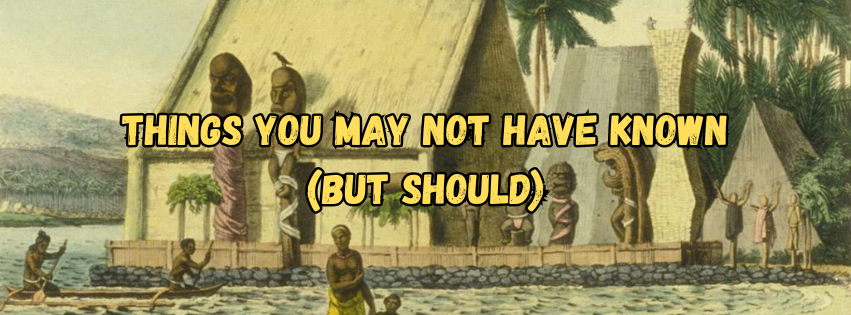
Amazing Things You May Not Have Known About Hawaii's Beautiful History
When most people think about Hawaii, beautiful beaches, towering waterfalls, and tropical weather usually come to mind first. While those natural wonders certainly deserve their reputation, Hawaii's history is every bit as remarkable as its landscapes.
Long before becoming the 50th state, Hawaii was home to a thriving Polynesian civilization, a powerful monarchy, and a culture that continues to influence daily life across the islands. Many traditions, customs, and historical landmarks remain deeply woven into modern Hawaii, offering visitors a chance to experience far more than a typical beach vacation.
Here are several fascinating pieces of Hawaiian history that make the islands unlike anywhere else in the United States.
Hawaii Was Once an Independent Nation
One of the biggest misconceptions about Hawaii is that it has always been part of the United States. In reality, Hawaii existed for decades as an internationally recognized sovereign kingdom.
Throughout the 1800s, the Hawaiian Kingdom established diplomatic relationships with countries around the world and maintained embassies in several foreign nations. Leaders from Europe, Asia, and the Americas officially recognized Hawaii's independence.
King Kalākaua became especially well known after embarking on a worldwide diplomatic journey in 1881, becoming the first reigning monarch to successfully travel around the globe. His travels helped strengthen international relationships while promoting Hawaiian interests abroad.

America Is Home to a Royal Palace
Many people are surprised to learn that the United States contains an authentic royal palace. Located in downtown Honolulu, ʻIolani Palace served as the official residence of Hawaii's monarchs during the Kingdom of Hawaii.
The palace reflected remarkable innovation for its era. It featured electric lighting, indoor plumbing, and modern conveniences before many prominent government buildings on the U.S. mainland, including the White House, adopted similar technology.
Today, visitors can tour the beautifully restored palace and learn about Hawaii's royal history through exhibits, artifacts, and guided tours.

Hawaii Once Had Another Name
When British explorer Captain James Cook reached the islands in 1778, he named them the Sandwich Islands. The name honored John Montagu, the Fourth Earl of Sandwich, who supported Cook's expeditions.
Although that name appeared on maps for many years, the traditional name "Hawaii" ultimately became the permanent identity of the island chain. Today, the older name survives primarily as a historical reference tied to European exploration.

The Hawaiian Language Nearly Disappeared
The Hawaiian language remains one of the state's greatest cultural treasures, but there was a time when it came dangerously close to disappearing.
Following the overthrow of Queen Liliʻuokalani in 1893, Hawaiian was prohibited as a language of instruction in many schools.
As generations passed, fewer families spoke Hawaiian at home, and the number of fluent speakers steadily declined. Beginning in the 1970s, however, educators, cultural organizations, and community leaders launched a determined effort to preserve the language.
Those revitalization efforts proved successful. Hawaiian immersion schools expanded, university programs grew, and younger generations once again began learning the language.
Today, both English and Hawaiian serve as Hawaii's official languages, making it the only state in the country with two official languages recognized statewide.

Ancient Hawaiians Were Master Navigators
Long before modern navigation technology existed, Polynesian voyagers crossed thousands of miles of open Pacific Ocean to reach Hawaii.
Using stars, ocean currents, wind patterns, cloud formations, and wildlife as guides, these highly skilled navigators accomplished one of history's greatest feats of exploration. Their knowledge allowed settlements to flourish across the islands centuries before European contact.
Traditional wayfinding techniques continue to be taught today through cultural education programs and voyages aboard replica Polynesian sailing canoes.

Hawaii Even Helped Prepare Astronauts
Not every piece of Hawaiian history involves kings or explorers. The Big Island's volcanic lava fields have also played an important role in modern space exploration.
Because portions of Hawaii's volcanic terrain closely resemble the surface of the Moon, NASA has used these landscapes during astronaut training and scientific research.
The rugged lava flows provide an ideal environment for testing equipment, practicing exploration techniques, and preparing astronauts for future missions beyond Earth.

Hawaii's History Lives On
One of the most remarkable aspects of Hawaii is how its history remains visible throughout everyday life.
Traditional hula, Hawaiian music, language, cultural festivals, canoe paddling, and local customs continue to celebrate generations of heritage rather than simply preserving it inside museums.
Visitors who take time to explore historic sites, attend cultural events, or learn about the islands' past often leave with a much deeper appreciation for Hawaii beyond its world-famous scenery.
Hawaii's Rich and Beautiful History is Always Worth Celebrating
Hawaii's story is one of exploration, innovation, resilience, and cultural pride. From its years as an independent kingdom and the grandeur of ʻIolani Palace to the revival of the Hawaiian language and even NASA's astronaut training on volcanic landscapes, the islands possess a history unlike anywhere else in the United States.
Learning about Hawaii's past adds another layer of appreciation to every visit, revealing that the beauty of the islands extends far beyond their beaches and into a rich cultural legacy that continues to thrive today.